To create a marketing funnel, start by defining the commercial outcome you need, the buyer who can realistically achieve it, and the path that moves that buyer from attention to profitable action. A funnel is not a diagram of awareness, consideration, and purchase. It is a revenue system with measurable handoffs, conversion points, and economic consequences.
For a CEO, the purpose of funnel building is not to create more campaigns or collect more leads. It is to identify where demand stops progressing and improve the constraint that limits profitable growth.
The search phrase “what is create a marketing funnel” points to a common misunderstanding. Creating a funnel does not mean adding a landing page, a lead magnet, and an email sequence. It means designing a coherent path between a real customer problem and a commercially viable outcome.
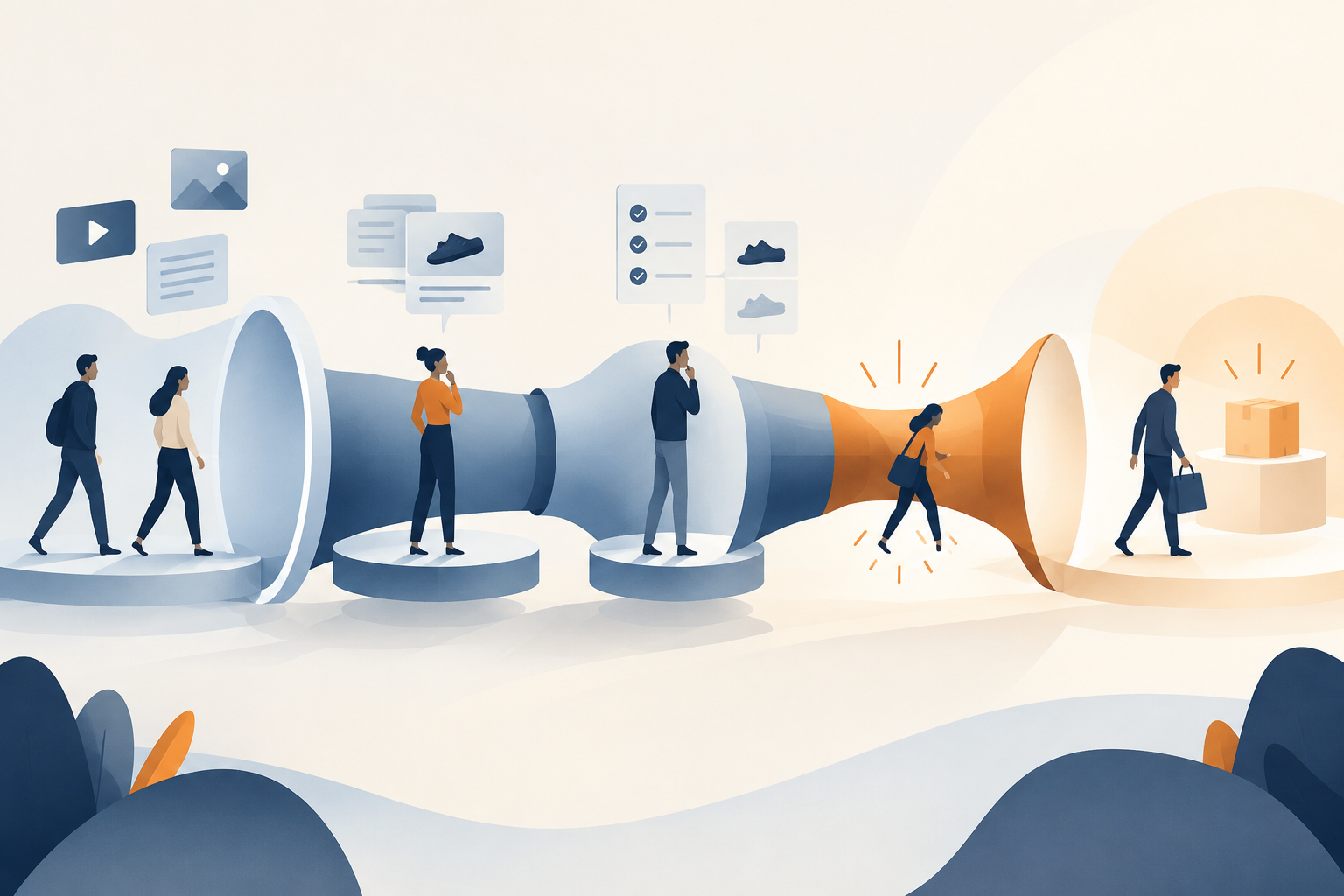
What does it mean to create a marketing funnel?
Creating a marketing funnel means building a measurable journey that helps the right buyer move from initial interest to purchase, enrollment, repeat purchase, or another defined commercial outcome.
A useful funnel connects six elements:
- Audience: The people with a relevant problem, need, or buying trigger.
- Demand: The level of awareness and intent those people bring into the journey.
- Offer: The product, program, service, or next step presented to them.
- Conversion path: The actions required to move from interest to commitment.
- Follow-up: The process that helps qualified prospects continue when they are not ready to act immediately.
- Measurement: The visibility needed to understand conversion, acquisition cost, margin, payback, and retention.
The broader Marketing Funnel: A CEO-Level Growth Guide is useful context here. The core leadership question is not, “Do we have a funnel?” It is, “Can we see how demand becomes profitable revenue, and can we identify where that process is breaking?”
What business outcome should the funnel support before you build it?
Start with the outcome that matters commercially, then work backward to design the funnel. A funnel built around a vague goal such as “more awareness” will often generate activity without a reliable connection to revenue.
The appropriate outcome may be:
- A first purchase
- A course enrollment
- A qualified consultation
- A subscription start
- A product trial that leads to paid conversion
- A repeat purchase or renewal
The right path depends on purchase complexity, price sensitivity, margin, buyer risk, time to value, and whether a person needs help selecting the right option. A low-consideration product and a high-consideration education program should not use identical conversion architecture.
What should Education businesses define before choosing a funnel path?
Education businesses should first define learner fit. That includes the learner’s starting point, desired outcome, eligibility, urgency, financial capacity, and ability to commit the required time and effort.
A prospective student may be interested in a topic but still be a poor fit for a specific program because they lack prerequisite knowledge, need a different format, cannot start during the enrollment window, or expect an outcome the program does not provide. Those are distinct qualification issues, not generic “lead quality” problems.
Leaders should also decide whether enrollment requires a sales conversation. A conversation can be valuable when it helps with fit assessment, program selection, financing considerations, stakeholder approval, or risk reduction. It becomes wasteful when it exists only because the business has not made the offer clear enough for a qualified buyer to self-select.
What should B2C businesses define before choosing a funnel path?
B2C businesses should define the economics and behavior of the purchase. Consider product consideration, purchase frequency, replenishment potential, checkout friction, contribution margin, return risk, and whether buyers need education before they can confidently choose.
A straightforward replenishable product may benefit from a short path from discovery to product page to checkout. A more complex product may require comparison tools, demonstrations, reviews, usage education, or stronger risk reduction before a purchase makes sense.
Who is the funnel built to convert and what problem are they trying to solve?
A funnel can only perform as well as its understanding of the customer and the problem being solved. If the audience definition is vague, the message will be broad, the offer will feel generic, and conversion data will be difficult to interpret.
Define the customer by the circumstances that make the offer relevant, not merely by age, location, or surface-level interests. A useful definition includes the buyer’s problem, current alternative, urgency, perceived risk, buying trigger, and reason for choosing now.
When prospects fail to progress, identify the actual failure mode. They may lack the required use case, have no urgent need, lack budget capacity, be ineligible, need approval from someone else, or be too early in their decision process. Each requires a different response. Treating all of them as one pool of “low-quality leads” prevents useful diagnosis.
What evidence should shape the customer and problem definition?
Use evidence from customer interviews, sales conversations, support interactions, product reviews, on-site behavior, purchase cohorts, cancellation reasons, and repeat-purchase patterns. Look for recurring language, recurring objections, and recurring moments that prompt people to act.
The goal is not to create a fictional persona document. It is to understand what buyers are trying to accomplish, what stops them, and what evidence they need before they can commit.
Which stages should your marketing funnel include?
Your funnel should reflect how your buyers make decisions, not a generic template copied from another business. Most effective funnels include some version of problem recognition, evaluation, commitment, conversion, onboarding, and retention.
| Buyer stage | Business question | Funnel responsibility |
|---|---|---|
| Problem recognition | Does the buyer understand the issue or opportunity? | Create relevance and clarify the problem. |
| Evaluation | Does the buyer believe your approach is appropriate? | Explain fit, alternatives, proof, and trade-offs. |
| Commitment | What uncertainty is preventing action? | Address objections, expectations, and risk. |
| Conversion | Can the buyer complete the next step easily? | Reduce avoidable friction in checkout, enrollment, or booking. |
| Onboarding and retention | Does the customer receive early value and continue? | Protect payback, repeat purchase, and long-term margin. |
For a deeper discussion of architecture, see Building A Marketing Funnel: A CEO-Level Growth Guide. The important point is that not every business needs every stage to be long or formal. The buyer’s level of uncertainty should determine the work the funnel must do.
When should a funnel include a sales conversation?
A funnel should include a sales conversation when the buyer needs diagnosis, program-fit guidance, stakeholder alignment, implementation clarity, or confidence around a meaningful financial or time commitment.
Sales is not a substitute for poor positioning. It is appropriate when human judgment materially improves the buyer’s decision. It is less appropriate when the offer is simple, self-evident, low-risk, and easy to purchase without assistance.
When should a funnel allow customers to buy directly?
A direct purchase path works when the buyer can understand the product, assess fit, see sufficient proof, and complete the transaction without needing individual guidance.
Direct checkout does not mean removing all decision support. It means giving buyers the information, reassurance, and usability they need to self-select confidently.
How should offers and messages change as buyer intent increases?
Messages should reduce uncertainty in sequence. Repeating the same top-level claim at every stage forces buyers to do the work of figuring out what matters next.
Early-stage buyers often need problem clarity. They may respond to useful education, a relevant insight, or a way to assess whether an issue applies to them. Mid-stage buyers need to understand alternatives, fit, and trade-offs. Conversion-stage buyers need confidence in the offer, the process, the commitment, and the next step.
What makes an early-stage offer worth engaging with?
An early-stage offer is worth engaging with when it helps a prospective buyer make sense of a real problem or decision. It may provide practical education, a diagnostic perspective, a comparison framework, or a clearer way to evaluate the status quo.
Not every early-stage asset needs to be gated. If a buyer must give up too much information before receiving any value, the business may create friction before trust has been established.
What makes a conversion-stage offer credible enough to act on?
A conversion-stage offer must clearly explain what the buyer receives, who it is for, what is required, what happens next, and why the decision is reasonable now. Credibility comes from clarity, appropriate evidence, transparent expectations, and a path that does not create unnecessary work.
Objective claims require support. This is particularly important in sensitive categories involving earnings, health, education outcomes, performance, or product efficacy. FTC guidance on advertising substantiation explains that businesses need a reasonable basis for objective express and implied claims before making them.
How should traffic sources connect to the funnel instead of operating separately?
Each traffic source should be evaluated by the intent it creates and the next step it supports. Paid media, organic search, creators, email, partnerships, and outbound can all contribute, but they should not be managed as isolated activity channels.
For example, a high-intent search visitor may need a direct path to a product page, enrollment page, or consultation. A buyer arriving from educational content may need more context before being asked to purchase. A creator audience may need a message that connects the creator’s recommendation to the buyer’s specific use case.
Do not increase or cut paid media based on platform-level results alone. Review CAC, conversion rates, contribution margin, payback period, cohort timing, and available cash. A channel can appear expensive at the click or lead level while still be commercially viable, or appear efficient while generating customers with weak retention or poor margin.
When evaluating external execution, Marketing Agency Performance: How CEOs Should Evaluate Agency Performance can help separate a vendor problem from a system problem. An agency may have execution gaps, but weak results can also come from an unclear offer, a mismatched landing experience, poor sales follow-up, or economics that cannot support acquisition at the available cost.
How can leaders tell whether the problem is traffic quality or funnel mismatch?
Traffic quality is the issue when the business consistently attracts people who do not have the necessary use case, urgency, capacity, or fit for the offer. Funnel mismatch is the issue when viable prospects arrive but encounter messaging, proof, pricing context, or conversion steps that do not match their intent.
These problems can look similar in a dashboard because both reduce conversion. The distinction matters because targeting changes may not fix a weak offer path, and landing-page changes may not fix demand generated from the wrong audience.
What should a CEO measure after creating a marketing funnel?
Measure the funnel as an economic system, not as a collection of vanity metrics. Traffic, impressions, and lead volume only matter when they contribute to qualified demand, customer conversion, margin, and acceptable payback.
At minimum, leadership should be able to see:
- Conversion between material journey stages
- Cost to acquire a customer
- Sales acceptance and close rates where sales is involved
- Contribution margin after acquisition and fulfillment costs
- Time to recover acquisition investment
- Retention, renewal, repeat purchase, refund, or cancellation signals
How do conversion rate, CAC, margin, and payback work together?
Conversion rate shows how effectively buyers move through a stage. CAC shows what it costs to acquire a customer. Margin shows whether revenue leaves enough economic value after relevant costs. Payback shows how quickly the business recovers its acquisition investment.
No single number is sufficient. A higher conversion rate may be unhelpful if it comes from discounting away margin. A lower CAC may be misleading if customers cancel quickly. Revenue growth can mask a cash problem when payback extends beyond what the business can comfortably fund.
How can funnel analysis reveal where buyers abandon the journey?
Funnel analysis helps leaders see where buyers stop progressing between defined actions. It can reveal whether people fail to move from ad to landing page, product page to cart, application to enrollment, or booked consultation to purchase.
Google Analytics funnel exploration guidance describes how teams can define journey steps, analyze completion and abandonment, and segment users to investigate meaningful differences in behavior. The point is not to produce more reports. It is to find the stage that deserves management attention.
If the buyer journey itself is unclear, Marketing Funnel Map: A CEO-Level Growth Guide can help clarify the decision points that should be visible.
What do practical marketing funnel examples look like for Education and B2C businesses?
Practical marketing funnel examples show how strategic choices change based on buying complexity. They are not universal templates, and they should not be treated as promises of performance.
What might an Education enrollment funnel look like?
An Education business offering a higher-consideration program may begin with content that helps prospective learners understand the skill gap, career goal, or learning challenge they face. From there, the buyer might review curriculum relevance, learner requirements, delivery format, time commitment, and credible evidence about the program experience.
If the program requires meaningful fit assessment, the next step may be an application or enrollment conversation. If learner fit is straightforward, the path may lead directly to enrollment. After enrollment, onboarding should help the learner start quickly and understand how to gain value from the program.
What might a B2C purchase funnel look like?
A B2C funnel may begin with product discovery through search, social content, creator partnerships, referrals, or paid media. The product page then needs to answer practical questions: what the product is, who it is for, how it works, why it differs from alternatives, and what the buyer should expect.
Trust signals, product education, delivery details, return information, and checkout usability can all affect conversion. The post-purchase experience then determines whether the first transaction becomes a repeat purchase, subscription, referral, or avoidable return.
A strong create a marketing funnel strategy treats both examples as connected commercial journeys, rather than separate marketing and operations projects.
How do you find the real constraint when the funnel underperforms?
Find the first material constraint in the buyer journey before adding more activity. More traffic, more content, more nurturing, or more sales outreach can obscure the problem if the actual limitation sits elsewhere.
Common constraints include:
- Insufficient demand from buyers with a relevant use case
- Weak message-to-market fit
- An offer that lacks differentiation, urgency, or perceived value
- Conversion friction in the application, checkout, or booking process
- Slow or inconsistent sales follow-up
- Weak onboarding that delays customer value
- Poor retention or repeat-purchase economics
- Measurement gaps that prevent reliable diagnosis
When is the funnel problem actually an offer problem?
The problem is likely the offer when the market understands the message but still does not see enough value, differentiation, relevance, or urgency to proceed. This often appears as reasonable engagement followed by hesitation at the point of commitment.
Do not assume the answer is a more aggressive promotion. First determine whether the offer matches the customer’s desired outcome, risk tolerance, budget context, and alternatives.
When is the funnel problem actually a measurement problem?
The problem may be measurement when teams use inconsistent stage definitions, disconnected systems, incomplete attribution, or reporting that cannot connect acquisition activity to customer economics.
In those situations, leaders may believe conversion is weak when tracking is incomplete, or believe acquisition is working when retention and payback are invisible. Better visibility does not solve a weak funnel by itself, but it prevents management from optimizing the wrong problem.
When should you rebuild the funnel and when should you improve one stage?
Rebuild the funnel only when the commercial model, customer segment, offer, buying journey, or measurement foundation has materially changed. Otherwise, improve the most consequential constraint first.
A full rebuild can be justified when the business has introduced a new category, shifted from direct purchase to a sales-assisted model, changed its core offer, entered a different customer segment, or lost the ability to measure the journey reliably.
In most cases, however, the better decision is targeted improvement. If qualified buyers reach the product page but do not purchase, investigate offer clarity, proof, pricing context, and checkout friction before launching a new awareness campaign. If sales conversations are booked but not accepted, investigate fit criteria, expectation-setting, and sales handoff before expanding lead generation.
This create a marketing funnel guide should lead to a simple executive discipline: diagnose first, then invest where the constraint is. Leaders who cannot reliably identify the bottleneck across demand, conversion, unit economics, and retention may benefit from a Growth Audit before committing further budget or internal resources.
What are the most common questions about creating a marketing funnel?
What is the first step to create a marketing funnel?
Define the commercial outcome and the customer who should reach it. Start with the purchase, enrollment, or retention event that matters, then work backward through the decisions a qualified buyer must make before taking that action.
How many stages should a marketing funnel have?
Use as many stages as needed to reflect meaningful buyer decisions and operating handoffs. A simple B2C purchase path may have only a few material steps. A higher-consideration Education funnel may require more stages because buyers need greater clarity and fit assessment.
Do all businesses need a lead magnet to create a marketing funnel?
No. A lead magnet is useful only when it provides genuine value and supports the buyer’s next decision. Businesses with high-intent demand may be better served by clear product, enrollment, or consultation paths rather than adding an unnecessary gated step.
How do you know whether your marketing funnel is profitable?
Assess profitability through the relationship between customer acquisition cost, conversion, contribution margin, retention or repeat purchase, payback timing, and cash capacity. Revenue or lead volume alone cannot establish whether the funnel is economically healthy.
What are the best create a marketing funnel examples to follow?
The best examples are businesses with similar buying complexity, customer risk, margin structure, and sales involvement. Do not copy surface-level tactics. Adapt the underlying decision path to your buyer, offer, and economics.
Related: building a marketing funnel.