CAC payback period measures how long it takes for the gross profit from a newly acquired customer to recover the cost of acquiring that customer. It answers a question every growth-stage CEO should be able to answer clearly: how long is the business financing growth before acquisition cash comes back?
A customer can look valuable on paper and still create a cash problem. If the business pays for acquisition upfront but collects slowly, carries high delivery costs, or faces meaningful refund exposure, growth can consume cash before it produces it. CAC payback period makes that timing visible.
That is why CAC should not be judged only by its headline number. The real leadership question is whether acquisition capital can be recycled at a pace the business can afford.
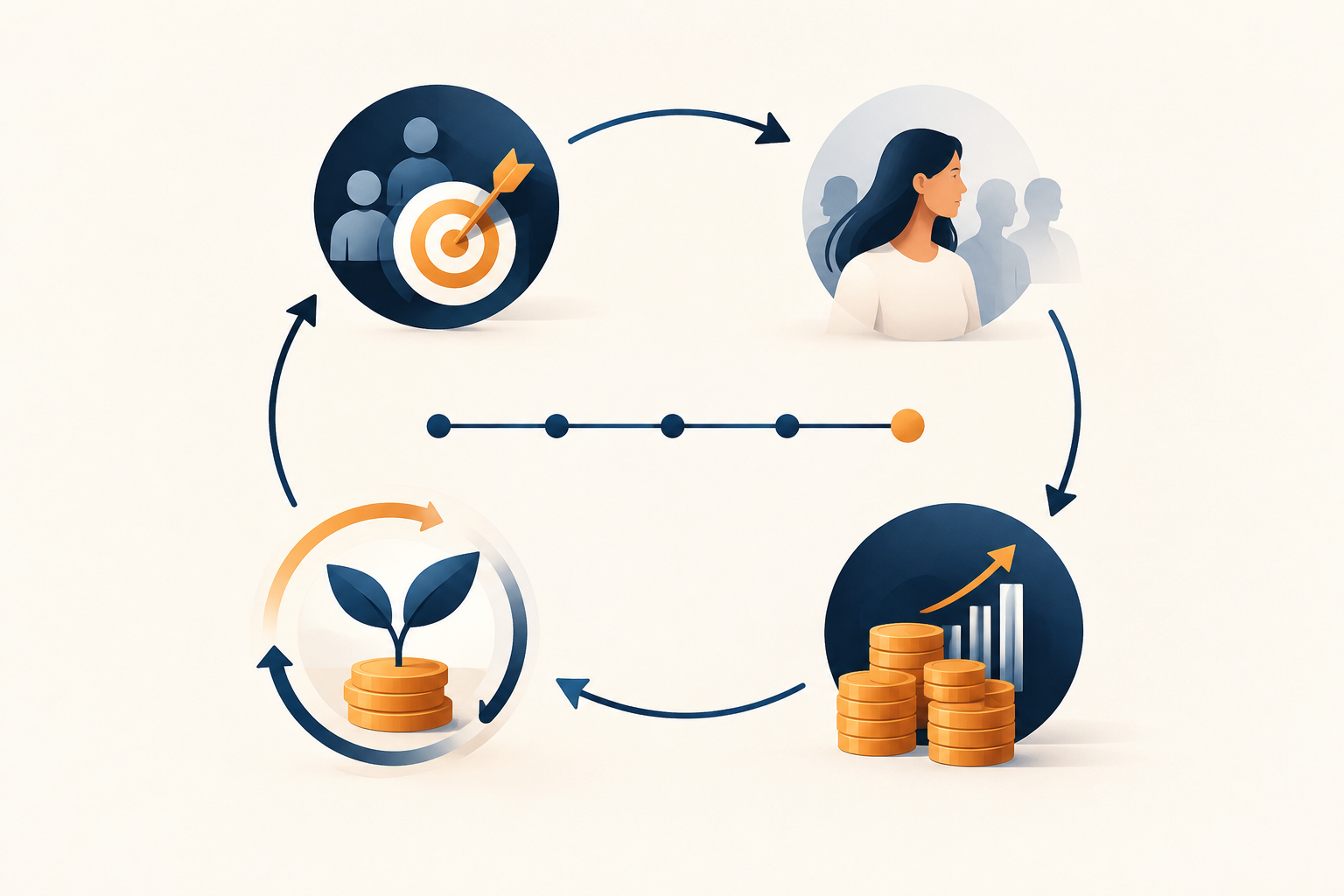
What is CAC payback period?
CAC payback period is the number of months required for a customer cohort to generate enough gross profit to cover the cost of acquiring it.
It is a cash-velocity metric. Customer acquisition cost tells you what it costs to win a customer. Payback tells you how long that cost remains unrecovered.
For an education business, this may mean the time required for course, programme, membership, or coaching gross profit to cover the marketing and sales cost associated with enrolment. For a B2C subscription business, it is usually the time required for monthly gross profit from a subscriber to recover acquisition cost.
The distinction matters because revenue and cash recovery are not the same thing. A business may book a sale at the point of purchase, but receive the cash in installments. It may collect upfront cash while delivering the service over time. It may also lose part of the expected value through refunds, failed payments, chargebacks, or early churn.
In practical terms, payback tells leadership how much growth the business can fund before working capital becomes the constraint. It sits alongside CAC, conversion, contribution margin, retention, and cash runway as part of a complete unit-economics view.
How do you calculate CAC payback period?
The basic CAC payback period formula divides acquisition cost by the monthly gross profit generated by the relevant acquired customer cohort.
A simple expression is:
CAC payback period = customer acquisition cost ÷ monthly gross profit per acquired customer
For example, if a business spends a certain amount to acquire a customer and receives a consistent monthly gross profit contribution from that customer, payback is the time needed for cumulative monthly gross profit to equal the original acquisition cost.
This simplified formula is useful when customer revenue, costs, and retention are reasonably stable. But leadership should not mistake a simple formula for a complete answer. Many education and B2C businesses have uneven collection schedules, variable fulfillment costs, refund windows, sales-assisted conversion cycles, or significant early churn. In those cases, cumulative cohort analysis is more reliable than a monthly average.
The widely used CAC payback period formula is directionally simple. The discipline comes from defining acquisition cost consistently and using a profit measure that reflects the true economics of serving the customer.
Which acquisition costs should be included in the calculation?
Include the costs that are directly required to create the acquired customer base you are measuring. The definition should be consistent across periods, channels, offers, and cohorts.
Depending on the business model, that may include:
- Paid media and media-related platform costs.
- Creative production and campaign execution directly tied to acquisition.
- Sales compensation or sales capacity used to convert new customers.
- Lead-generation partners, affiliates, or referral incentives.
- Tools and operational costs that are directly attributable to new-customer acquisition.
The point is not to create a theoretical perfect number. It is to avoid a misleading one.
If paid media is counted but the sales effort required to close those leads is excluded, payback may appear faster than it really is. If a business includes broad corporate overhead in one period but not another, trend comparisons become unreliable. A useful definition is one leadership can apply consistently and connect to actual acquisition decisions.
Why should the formula use gross profit rather than revenue?
Payback should generally use gross profit because revenue does not show how much cash contribution the customer actually creates after direct delivery costs.
A customer who pays the same amount can have very different economics depending on the cost to serve them. For example, a programme with live coaching, enrolment support, payment processing, course delivery, community management, and customer success costs may produce materially less gross profit than its top-line revenue suggests.
Using revenue can make payback look artificially fast. Gross profit provides a more commercially honest view because it accounts for the direct cost of delivering what was sold.
| Measure | What it tells leadership | Common risk |
|---|---|---|
| Revenue payback | How quickly booked or collected revenue equals acquisition cost | Can overstate the cash contribution available to recover CAC |
| Gross profit payback | How quickly direct customer contribution recovers acquisition cost | Requires a clear and consistent treatment of direct costs |
| Contribution payback | How quickly customer contribution after selected variable operating costs recovers CAC | Can become inconsistent if cost definitions shift between periods |
Why does payback speed matter to profitable scaling?
Payback speed matters because growth consumes cash before it returns cash. The slower the recovery, the more capital the business must carry to sustain acquisition.
When acquisition cash returns quickly, the business can reinvest from a stronger position. When it returns slowly, growth may require more working capital, more financial patience, or a lower pace of acquisition until the economics improve.
This is particularly important when a business is increasing lead volume, entering a new market, hiring sales capacity, or introducing a new offer. Those moves often increase cash outflow before the associated cohort has matured enough to prove its contribution.
A company can therefore report growing revenue while becoming more cash constrained. That is not automatically a marketing failure. It may be the natural result of payment terms, gross margin, fulfillment cost, refund timing, or a decision to invest ahead of recovery. But it must be visible and intentional.
For a broader view of how CAC, margins, conversion, retention, and cash fit together, leadership should treat payback as one part of the company’s unit-economics model rather than an isolated marketing metric. The relevant question is not simply whether a campaign can generate customers. It is whether the business can acquire, serve, and retain those customers while preserving enough cash to continue operating and investing.
How do gross margin and payment terms change CAC payback?
Gross margin and payment terms can change payback materially even when CAC and customer value appear identical.
Consider two offers with the same acquisition cost and the same total contract value. One is paid largely upfront and has low delivery costs. The other is paid over time, requires high-touch service, and has meaningful refund exposure. The headline customer value may be similar, but the second offer will usually recover acquisition cash more slowly and with greater uncertainty.
This is why booked revenue alone is not enough for growth decisions. Leadership needs to understand when cash is collected, what portion is likely to remain after refunds or failed payments, and how much gross profit is released as the customer is served.
How does an upfront payment change the cash picture?
An upfront payment can improve acquisition cash recovery because the business collects more cash earlier. But it does not eliminate the need to assess margin and delivery obligations.
For education, coaching, and membership businesses, cash collected at enrolment may arrive before the programme is delivered. That can support near-term cash flow, but the business still carries the obligation to fulfill the service and may face a refund period or future support costs.
Leadership should distinguish among three views:
- Cash collected: What has actually reached the business.
- Revenue recognized: What has been earned under the business’s accounting treatment.
- Gross profit contribution: What remains after direct costs required to serve the customer.
Each view is useful. None should be used as a substitute for the others.
How do installments and refunds extend payback?
Installments and refunds extend payback when they delay or reduce the gross profit the business expected to receive from the acquired cohort.
An installment plan can improve conversion by reducing the customer’s initial commitment. It can also create a longer period between acquisition spend and cash recovery. If collections weaken after the first payment, the business may carry acquisition cost while only part of the expected customer value is realized.
Refunds, chargebacks, payment failures, and cancellations have a similar effect. They do not merely reduce reported revenue. They can turn an apparently acceptable CAC into a slower or weaker cash-recovery profile once cohort behavior becomes clear.
This is the timing gap between acquisition costs and subscription cash recovery that leaders must plan for in recurring and installment-based models. Acquisition spend is often immediate. Customer cash contribution usually arrives over time and may not arrive as originally forecast.
Why should CAC payback be measured by cohort?
CAC payback should be measured by cohort because blended averages can hide a deteriorating business model.
A blended number may combine customers acquired months ago under lower media costs, stronger conversion, different pricing, or better retention with customers acquired recently under very different conditions. The average can look acceptable while the newest cohorts are taking longer to recover their cost.
A cohort view groups customers by a shared acquisition period, channel, offer, or meaningful segment, then tracks how their economics mature. This helps leadership see whether changes are structural or temporary.
Useful cohort comparisons may include:
- Customers acquired before and after a pricing or offer change.
- Customers from different acquisition channels.
- Customers sold through different sales paths.
- Customers on upfront-payment versus installment plans.
- Customers in distinct product, programme, or membership segments.
The objective is not reporting complexity. It is decision quality. If a recent cohort is slower to pay back, leadership needs to know whether the cause is a higher acquisition cost, lower conversion, weaker payment collection, increased refunds, reduced margin, or weaker early retention.
What is a good CAC payback period?
A good CAC payback period is one the business can finance safely while preserving sufficient margin, cash resilience, and confidence in cohort performance. There is no universal number that applies across every education or B2C business.
A short payback period is generally less demanding on cash than a long one. But the right threshold depends on the company’s economics and operating reality. A high-margin business with substantial available cash, reliable collections, stable retention, and predictable demand can tolerate a different profile from a business with tight cash reserves, high fulfillment costs, uncertain cohorts, or long payment schedules.
When someone asks, “what is a good CAC payback period?”, the more useful response is another question: good relative to what?
The answer should be tied to the business’s ability to fund acquisition before customers have fully repaid it, not copied from a generic benchmark.
What should leadership compare instead of relying on a universal benchmark?
Leadership should compare payback with the company’s cash capacity, contribution margin, cohort stability, and growth commitments.
- Cash runway: Can the business fund acquisition and normal operations while recent cohorts mature?
- Gross margin: Is there enough customer contribution to recover CAC without relying on distant future value?
- Collection timing: When does the business actually receive the cash it expects?
- Refund and payment risk: How much early customer value reverses or fails to collect?
- Cohort consistency: Are recent cohorts behaving as expected, or is recovery becoming slower?
- Growth plan: How quickly does the business need to reinvest capital to meet its operating commitments?
A business with slower payback may still be strategically sound. But it should be funded and managed as a slower-payback business. Problems arise when leadership makes aggressive acquisition commitments using assumptions built for a faster cash cycle.
How does CAC payback interact with LTV and allowable CAC?
LTV tells you whether a customer may be valuable over the relationship. CAC payback tells you how long the business must wait to recover the acquisition investment. Both matter, and neither replaces the other.
A business can have an attractive projected LTV to CAC ratio and still have weak payback. This often happens when most customer value arrives later through renewals, recurring payments, repeat purchases, or future upsells. The eventual customer value may be compelling, but the business still has to finance the period before that value is realized.
Allowable CAC should therefore be set with more than theoretical lifetime value in mind. It should reflect margin, confidence in retention, payment timing, refund exposure, available cash, and the level of uncertainty in the forecast.
For a mature offer with stable cohorts, leadership may have more confidence in future value. For a new offer, new channel, or recently changed sales process, it is safer to place more weight on early cash contribution and observed cohort behavior.
The CEO-level question is straightforward: if future customer value arrives later than acquisition cost recovery, who finances the gap and under what level of risk?
What should leadership do when CAC looks healthy but payback is weak?
When CAC looks healthy but payback is weak, leadership should identify where customer cash contribution is being delayed, reduced, or lost. Do not assume the problem is media performance simply because acquisition spending is visible.
The failure mode is usually more specific than “lead quality.” It may be that leads who meet the initial targeting criteria are not converting after a sales conversation, that buyers select payment plans they do not complete, that refund rates rise after onboarding, or that direct fulfillment costs absorb more of the sale than expected.
The most common areas to investigate are:
- Acquisition cost rising faster than conversion or gross profit.
- Sales conversion weakening after lead capture.
- Payment-plan collection slowing or failing.
- Refunds, cancellations, or chargebacks increasing.
- Direct delivery costs increasing with customer volume.
- Early retention weakening in a subscription or membership model.
- Offer positioning attracting customers whose needs do not match the delivery model.
A clear CAC definition remains essential in this diagnosis. Customer Acquisition Cost (CAC): How CEOs Should Calculate and Use It provides the broader acquisition-cost context. The Marketing Funnel: A CEO-Level Growth Guide is also relevant when the breakdown sits between inquiry, qualification, sales conversion, and post-purchase activation.
When is the problem acquisition efficiency?
The problem is acquisition efficiency when the cost to produce a customer has increased or when the acquisition path produces fewer customers from comparable demand.
Examples include higher media costs, weaker creative response, a less competitive offer, lower landing-page conversion, slower sales follow-up, or declining close rates among prospects who meet the business’s defined qualification criteria.
In this case, the issue occurs before or at the point of customer acquisition. The business is spending more to produce the same customer outcome, or converting a smaller share of viable demand.
When is the problem offer and cash design?
The problem is offer and cash design when customers can still be acquired efficiently but the economics after the sale delay recovery or reduce contribution.
This can include installment structures with weak collection performance, delivery models that require too much high-cost labour, refund policies that create substantial reversals, poor early onboarding, or retention that falls below the assumptions used to fund acquisition.
Paid acquisition may be functioning acceptably in those circumstances. Reducing or changing media activity without addressing the downstream constraint may treat the symptom rather than the cause.
How should marketing, finance, and agencies use payback together?
Marketing, finance, and agencies should use payback as a shared decision metric because no single team controls the full economics of customer recovery.
Marketing owns demand generation, message-market fit, conversion paths, and channel performance. Finance owns cash visibility, margin discipline, and the company’s ability to fund growth. Sales and customer teams affect conversion, payment completion, retention, and refunds. Agencies may contribute media buying, creative, analytics, or campaign execution.
An agency can improve campaign execution and still be unable to solve a margin problem, an installment-collection problem, or weak customer retention. Equally, a business should not dismiss a channel issue as a system problem when acquisition costs are genuinely rising or conversion is declining.
The leadership task is to separate vendor performance from system performance. Payback provides a common language for doing that. It connects acquisition activity to the gross profit and cash timing that determine whether growth is financially sustainable.
A strong operating discussion asks: Which cohorts are recovering acquisition cost as expected? Where is recovery slowing? Is the constraint in demand, conversion, sales execution, payment collection, fulfillment cost, retention, or cash capacity? Those questions lead to better decisions than judging growth from revenue or lead volume alone.
\nHow should a CEO set CAC payback context?
\nWhich assumptions belong in the calculation?
\nMake the calculation reflect gross margin, payment timing, refunds, fulfillment, retention, and the way customers actually pay. The useful question is not whether one payback benchmark looks good. It is whether the cash comes back in a timeframe the business can support while preserving room to operate.
\nHow should the payback window match the buying cycle?
\nUse a window that matches the customer journey and cohort maturity. Short sales cycles may provide evidence quickly, while longer cycles require patience and more careful separation of early signals from durable economics.
\nHow should finance, marketing, and agencies share payback accountability?
\nWho owns the inputs?
\nFinance should help define the economic logic, marketing should connect acquisition decisions to customer quality, sales should explain conversion and timing, and the agency should make its controllable contribution visible. Shared accountability works only when the inputs and handoffs are documented.
\nHow should payback influence allocation?
\nUse payback alongside margin, demand quality, capacity, and the cost of learning. A channel with slower recovery may still be strategically useful, while a fast-looking channel can be risky if customer quality or retention is weak.
\nHow should a CEO respond when CAC payback deteriorates?
\nWhat should be investigated first?
\nCheck mix, offer, conversion, sales follow-up, pricing, fulfillment, retention, tracking, and payment terms before blaming one channel. Deterioration can come from a change in the revenue system rather than from media execution alone.
\nWhen should a CEO watch the VSL and book a Growth Audit?
\nWatch the VSL and then book a Growth Audit when payback is worsening but the business cannot agree whether the cause is acquisition, conversion, margin, cash design, or retention. The audit can clarify the next decision before the company cuts or adds spend on incomplete evidence.
\n\nFrequently asked questions about CAC payback period
\n\n\nThe standard formula is customer acquisition cost divided by monthly gross profit per acquired customer. For businesses with uneven collections, refunds, or changing delivery costs, calculate cumulative gross profit by cohort until it equals the acquisition cost.
Use the cash and gross profit actually realized from the installment cohort over time, not the full contract value assumed at signup. Account for payment timing, failed payments, refunds, chargebacks, and direct costs of serving the customer.
It should generally be based on gross profit because revenue does not reflect the direct costs required to deliver the product or service. Revenue payback may be useful as a supplementary cash-collection view, but it can overstate economic recovery.
Yes. A business may expect strong lifetime value from renewals, repeat purchases, or long-term subscriptions while still waiting a long time to recover acquisition cost. That can create working-capital pressure even when long-term customer economics appear attractive.