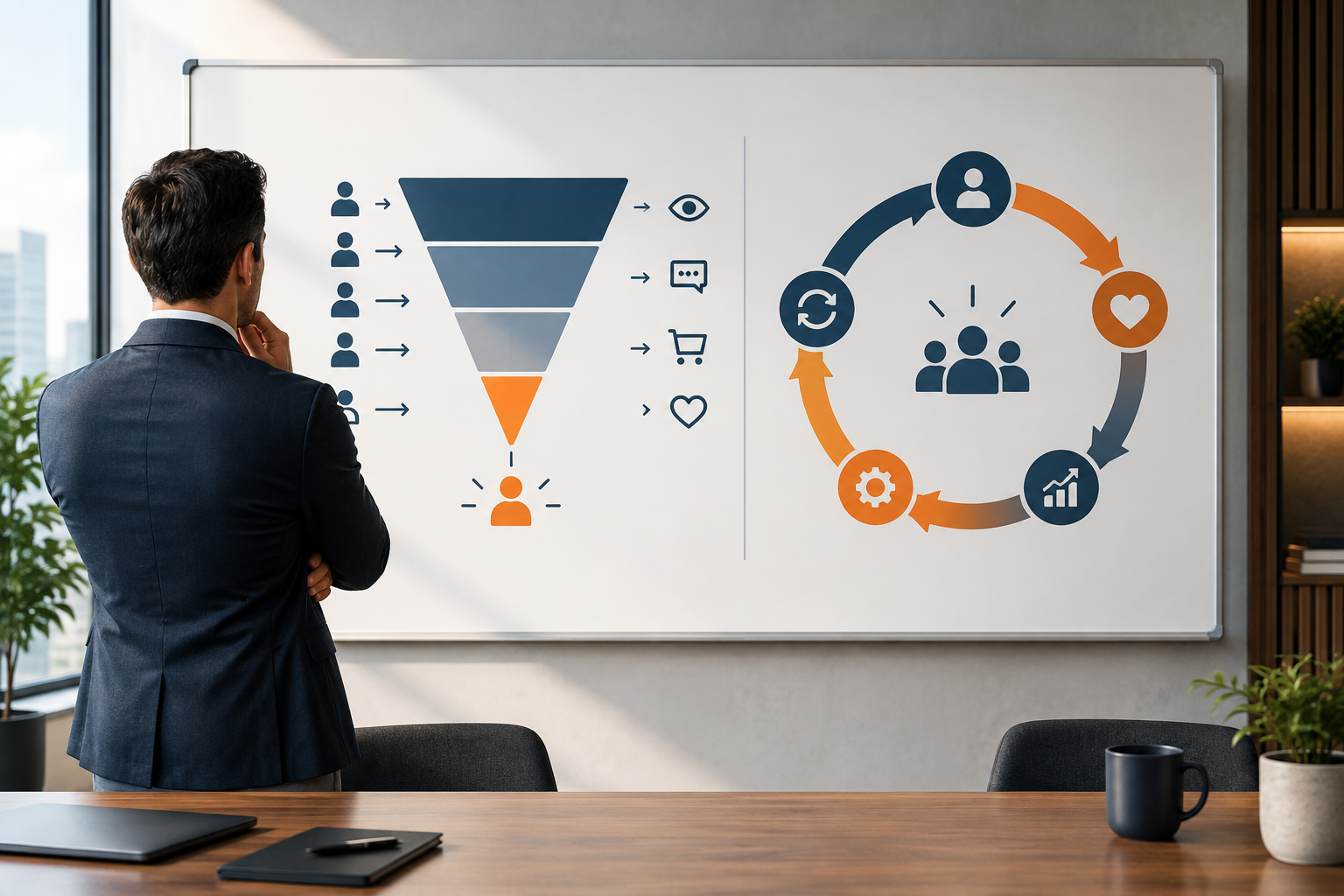
The marketing funnel vs flywheel debate is often framed as a choice between an outdated linear model and a modern customer-centric one. That framing is wrong. A funnel and a flywheel answer different management questions, and most growth-stage Education and B2C businesses need elements of both.
A funnel helps leadership see where prospective customers stop progressing toward purchase. A flywheel helps leadership understand whether the customer experience creates retention, repeat purchase, advocacy, and more efficient future demand.
The CEO decision is not which diagram looks better in a board deck. It is which part of the revenue machine is currently constraining profitable growth. Use the funnel stages guide to diagnose progression and the marketing ROI framework to judge economics.
What Exactly Is Being Compared in Marketing Funnel Vs Flywheel?
A funnel models movement toward a conversion. A flywheel models how value delivered after conversion can create momentum through retention, referrals, and repeat demand.
What a marketing funnel is designed to control
A marketing funnel is a diagnostic model for the buying journey. It breaks a commercial path into stages such as awareness, consideration, inquiry, qualification, sales conversation, purchase, and early activation.
Its primary value is control. A CEO can ask where the commercial system is losing people and whether the loss is commercially acceptable.
For example, if demand volume is healthy but sales conversations are not converting, the problem may sit in offer clarity, qualification criteria, follow-up speed, sales capability, pricing architecture, or buyer confidence. More traffic would not solve that constraint.
The funnel is particularly useful when a business needs to understand:
- Whether demand is reaching the right audience.
- Whether prospects understand the offer and its value.
- Whether inquiry handling and sales follow-up are effective.
- Whether acquisition cost can be recovered within an acceptable payback period.
- Whether conversion losses are caused by marketing, sales, product, or operational friction.
What a flywheel is designed to strengthen
A flywheel is a model for customer momentum. It treats the post-purchase experience as a growth input rather than a delivery function that begins after marketing ends.
The flywheel metaphor is useful because it emphasizes that customer outcomes can affect future acquisition economics. Customers who activate quickly, achieve the promised result, renew, repurchase, or recommend the business may reduce dependence on cold acquisition over time.
That does not mean a flywheel automatically produces referrals or lowers customer acquisition cost. It means the business has a reason to measure whether customer value realization creates those effects.
Why the two models answer different management questions
The funnel asks: “How efficiently do we turn attention into customers?”
The flywheel asks: “How effectively do we turn customers into lasting value, retention, and future demand?”
Neither question is optional. A business that cannot convert demand has an acquisition problem. A business that acquires customers but cannot retain them, help them activate, or deliver the promised outcome has a customer-value problem.
How Do the Options Differ in Strategy, Execution and Control?
The key difference is operating emphasis. Funnel strategy prioritizes progression to purchase. Flywheel strategy prioritizes value delivery across the full customer relationship.
| Area | Funnel-led emphasis | Flywheel-led emphasis |
|---|---|---|
| Primary question | Where does conversion break down? | Where does customer momentum weaken? |
| Core focus | Demand capture, qualification, conversion | Activation, outcomes, retention, advocacy |
| Typical owner | Marketing and sales leadership | Cross-functional leadership |
| Main risk | Winning the sale without delivering the promise | Improving experience without acquisition discipline |
| Useful economic lens | CAC, conversion, margin, payback | Retention, repeat purchase, expansion, referral contribution |
Funnel strategy prioritizes progression through a buying decision
A funnel-led strategy is most useful when the business needs visibility and control before purchase. It forces management to define what qualified demand actually means.
Qualified demand is not simply a large number of inquiries. It is demand from people with an identifiable problem, sufficient fit for the offer, realistic ability to buy, and a credible likelihood of progressing through the buying process.
For an Education business, the failure may be that prospects are attracted by an outcome claim but do not have the time, readiness, budget, or commitment needed to complete the program. For a B2C business, the issue may be that product pages create interest but fail to resolve delivery expectations, product suitability, return concerns, or price justification.
Flywheel strategy prioritizes value delivery across the customer relationship
Flywheel thinking broadens leadership attention beyond the purchase event. It asks whether acquisition promises align with onboarding, product use, customer support, delivery, and the customer’s ability to achieve a meaningful result.
Research on customer journey touchpoints is relevant here because a customer’s perception is formed across more than brand-owned advertising. Sales conversations, onboarding emails, product interactions, service experiences, social proof, peer discussion, and support all shape the commercial relationship.
For CEOs, that means retention cannot be assigned solely to customer success, just as conversion cannot be assigned solely to marketing.
Control requires clear ownership at every critical handoff
A funnel can create a false sense of control if teams only manage their own stage. Marketing may celebrate booked calls. Sales may blame lead fit. Delivery may inherit customers who were sold an expectation the business cannot reliably fulfill.
A flywheel can create a different problem if everyone owns the customer experience in theory but nobody owns specific commercial outcomes in practice.
The answer is not more meetings. It is explicit ownership of the handoffs that shape qualification, conversion, activation, retention, and advocacy.
Which Business Economics Should Determine the Choice?
Unit economics should determine the emphasis, not a preference for funnel language or flywheel language.
Before changing a growth model, leadership needs a credible view of acquisition cost, gross or contribution margin, conversion performance, payback timing, repeat purchase behavior, churn or cancellation patterns, and cash availability.
When acquisition economics make funnel discipline non-negotiable
Funnel discipline is essential when the business does not know where acquisition economics are breaking.
If CAC is rising, sales conversion is inconsistent, margins are narrow, or cash payback is slow, the immediate management priority is usually to identify the pre-purchase constraint. That may be positioning, demand quality, qualification, sales process, offer design, or conversion friction.
Paid media is not inherently the problem. Nor is an agency automatically the problem. A vendor may be executing competently within a system that has unresolved offer, sales, measurement, or delivery weaknesses. Conversely, weak execution can exist even when the wider system is sound. CEOs need to distinguish the two.
When retention and expansion economics justify flywheel investment
Flywheel investment becomes more important when the business has meaningful post-purchase value creation.
This is common when customers need onboarding to realize value, when subscription or repeat-purchase behavior matters, when learning outcomes drive renewals, or when a strong experience can produce credible referrals and advocacy.
For example, an Education company may acquire learners efficiently but lose momentum because early engagement is weak and customers do not reach the milestones that make renewal or recommendation likely. The acquisition funnel may be functioning. The growth constraint may sit after purchase.
Why more traffic magnifies an unresolved conversion or delivery constraint
More traffic amplifies whatever system it enters.
If the business has weak qualification, more traffic creates more sales effort with little commercial return. If the offer is unclear, more traffic produces more confused prospects. If onboarding is poor, more traffic produces more customers entering an experience that may damage retention and reputation.
Growth spending should therefore be evaluated against CAC, conversion, contribution margin, cohort timing, payback, and cash context. Traffic volume alone is not a growth strategy.
How Do Cost Structures Differ Between a Funnel and a Flywheel?
The cost difference is not simply media spend versus customer success spend. It is where the business chooses to invest management attention, capacity, technology, expertise, and operating discipline.
Funnel costs concentrate around demand capture, conversion, and sales capacity
A funnel-led model often requires investment in positioning, creative, content, media management, landing experiences, sales capacity, qualification, follow-up, conversion reporting, and testing.
These are not merely marketing costs. In many businesses, the most expensive pre-purchase inefficiency is sales capacity spent on prospects who do not fit the offer or are not ready to buy.
Flywheel costs concentrate around onboarding, experience, retention, and advocacy
A flywheel-led model often requires stronger onboarding, product education, customer support, service recovery, community, lifecycle communication, customer insight, and retention management.
For a B2C brand, this may involve improving first-use experience, fulfillment clarity, service responsiveness, and repeat-purchase relevance. For an Education business, it may involve helping customers begin, participate, apply learning, and sustain progress.
These costs should not be treated as soft brand investments. They should be evaluated through customer economics and the business’s ability to capture value over time.
How to evaluate cost through contribution margin and payback rather than channel preference
The right question is not whether acquisition or retention deserves more budget. The right question is where an incremental investment is most likely to improve profitable growth within the company’s margin and cash constraints.
A CEO should assess:
- What it costs to acquire a customer.
- What contribution margin remains after direct costs.
- How long it takes to recover acquisition cost.
- What percentage of customers activate and remain engaged.
- Whether repeat purchase, renewal, or referrals are material and measurable.
- Whether operational capacity can support additional demand without damaging experience.

Which Model Creates Clearer Accountability?
A funnel usually creates clearer stage-level accountability. A flywheel creates a more complete view of customer value, but it requires stronger cross-functional leadership to avoid blurred ownership.
What funnel accountability makes easier to diagnose
Funnels make it easier to identify where a commercial path leaks. Leadership can see whether the primary issue is attention, inquiry, qualification, show rates, sales conversion, checkout completion, or early cancellation.
That visibility is valuable because different failure points require different decisions. A conversion issue should not be treated as a reach issue. A qualification issue should not be treated as a creative issue. A sales capacity issue should not be treated as a media issue.
What flywheel accountability makes harder to assign
Flywheel outcomes often span teams. Retention may depend on what marketing promised, what sales represented, what onboarding delivered, how the product performed, and how support responded when the customer encountered friction.
That makes accountability harder, but not optional. CEOs need one commercial view of the customer journey rather than separate departmental reports that explain away the same problem from different angles.
How CEOs can prevent teams from passing the problem downstream
Use shared commercial definitions. Agree on what a qualified opportunity, successful activation, retained customer, and meaningful advocacy signal look like for your business.
Then manage the handoffs. If sales repeatedly closes customers who cancel quickly, the issue may be qualification, expectation setting, product fit, or onboarding. If marketing drives inquiries that never progress, the issue may be message-to-market fit, targeting, offer structure, or follow-up.
The objective is not to assign blame. It is to identify the constraint before it consumes more budget and management time.
How Do Speed, Expertise and Internal Capability Change the Choice?
A focused funnel improvement can often generate faster commercial learning. A flywheel improvement often requires broader operational change because the customer experience extends beyond the marketing team.
When a focused funnel improvement can produce faster learning
If the business has adequate demand but inconsistent conversion, leadership can often learn quickly by improving measurement, tightening qualification, clarifying the offer, and addressing friction in the buying journey.
This does not mean every funnel problem has a quick fix. Complex purchases, long decision cycles, and weak category awareness require patience. But a well-managed funnel makes the next commercial question clearer.
When a flywheel requires operational change beyond the marketing team
A flywheel cannot be built through lifecycle emails alone. If customers do not achieve value because onboarding is confusing, product adoption is difficult, fulfillment is unreliable, or support is fragmented, the business needs operating change.
That is why flywheel strategy is often harder to execute than it appears. It asks the company to connect promise, purchase, delivery, and customer outcome.
How a fractional CMO can support the decision
A fractional CMO can advise on the growth model, lead existing marketing and commercial resources, and bring trusted execution partners when the scope requires it. The role is most useful when leadership needs a clear diagnosis, stronger commercial accountability, and coordinated action across functions.
The goal is not to add another layer of marketing activity. It is to make the revenue machine more legible and direct resources toward the highest-leverage constraint.
What Are the Biggest Risks of Each Model?
Both models fail when they become slogans rather than management systems.
The funnel risk: optimizing conversion into a weak customer experience
A funnel can become too focused on the transaction. Teams may improve conversion rates while ignoring whether customers receive what they were led to expect.
This creates short-term performance at the cost of cancellation, returns, poor reviews, weak retention, and damaged trust. The commercial promise and delivered experience must remain aligned.
The flywheel risk: using retention language to avoid acquisition accountability
A flywheel can become an excuse for weak acquisition discipline. Customer experience matters, but it does not eliminate the need for clear positioning, qualified demand, accurate attribution, sales competence, and controlled CAC.
A business cannot refer its way out of an unclear offer or an unprofitable acquisition model.
The shared risk: measuring activity instead of economic progress
Both models can produce vanity reporting. Funnel teams can overvalue impressions, clicks, and inquiries. Flywheel teams can overvalue engagement, content consumption, or community activity without linking those signals to customer value and commercial outcomes.
The CEO standard should be economic progress: healthier conversion, stronger contribution margin, credible payback, better retention, more repeat demand, and a customer experience capable of supporting growth.
When Should a Business Move From a Marketing Funnel to Flywheel Thinking?
A business should not permanently “graduate” from a marketing funnel to flywheel thinking. It should expand its operating model when post-purchase value becomes a meaningful growth constraint.
The move from a marketing funnel to flywheel mindset makes sense when leadership can see that customer activation, completion, retention, renewal, repeat purchase, or advocacy materially affects future growth.
Common signals include:
- Customers buy but do not begin using the product or service quickly.
- Early cancellation or refund patterns undermine acquisition economics.
- Repeat purchase or renewal is important but inconsistent.
- Customer outcomes vary widely despite similar acquisition sources.
- Referrals occur informally but are not understood as an economic growth input.
- Marketing promises and delivery reality are not consistently connected.
The funnel still matters after this shift. The business still needs to know how prospects progress to purchase, what acquisition costs, and when that cost is recovered. Flywheel thinking adds the post-purchase system that determines whether the company can grow with stronger customer economics.

When Does a Hybrid Marketing Funnel and Flywheel Model Make Sense?
A hybrid marketing funnel and flywheel model makes sense for most growth-stage Education and B2C businesses because acquisition and customer value are economically connected.
Use funnel discipline before purchase. Use flywheel discipline after purchase. Connect them through an honest promise that the business can consistently deliver.
Use the funnel to identify the highest-leverage pre-purchase bottleneck
Start by identifying the most commercially important pre-purchase failure. Is demand insufficient? Is the offer attracting poor-fit prospects? Are leads not receiving timely follow-up? Are sales conversations not converting? Is checkout friction suppressing purchase?
Do not attempt to optimize every stage at once. The highest-leverage constraint is usually more important than a broad list of minor improvements.
Use flywheel principles to improve activation and customer outcomes
After purchase, focus on whether customers reach the first meaningful value moment. In Education, that may mean beginning the program, participating consistently, and making progress toward the promised transformation. In B2C, it may mean successful first use, confidence in the product, and a reason to return.
Activation is often where the acquisition promise becomes commercially real.
Connect acquisition promises to the delivered experience
The strongest hybrid model creates continuity. Marketing communicates a clear promise. Sales or checkout reinforces the correct expectation. Onboarding helps the customer act. Delivery supports the result. Retention and advocacy become possible because the experience matches the reason the customer bought.
This is not a branding exercise. It is a revenue system.
What Decision Matrix Should a CEO Use?
Choose the dominant emphasis based on the immediate constraint and the economics of the business.
| If this is true | Primary emphasis | Leadership priority |
|---|---|---|
| Conversion is inconsistent, CAC is unclear, or payback is under pressure | Funnel-first | Diagnose demand, qualification, conversion, margin, and cash recovery |
| Customers buy but fail to activate, retain, renew, or repurchase | Flywheel-first | Improve customer value realization and post-purchase ownership |
| Both acquisition and retention materially shape profitability | Hybrid | Connect pre-purchase promise to customer outcomes and retention |
| Purchase frequency is low and referrals are limited | Funnel-first, with service discipline | Improve conversion economics without assuming advocacy will carry growth |
| Customer lifetime value depends on recurring engagement or repeat behavior | Hybrid or flywheel-weighted | Protect activation, retention, and expansion economics |
The right model may change as the company changes. A newer business may need rigorous funnel control to establish repeatable acquisition. A more established business may need to protect retention and customer outcomes as it scales. The decision should follow evidence, not fashion.
What Should You Measure Before Changing the Growth Model?
Measure the economics, the buying journey, and the customer journey before changing strategy. No framework compensates for unknown unit economics or an unowned constraint.
The minimum economic view: acquisition cost, contribution margin, and payback timing
Leadership should understand what it costs to acquire a customer, what margin remains after direct costs, and how long it takes to recover acquisition investment. This view provides the cash and profitability context for every growth decision.
The minimum funnel view: progression, conversion, and leakage by stage
Track how prospects move from first contact to purchase. Focus on material losses, not reporting volume. The objective is to identify whether the constraint sits in demand generation, qualification, sales conversion, checkout, or another pre-purchase handoff.
The minimum customer view: activation, retention, repeat purchase, and advocacy signals
Track whether customers reach meaningful value, remain engaged, renew or repurchase where relevant, and recommend the business in ways that can be observed. Do not treat these as isolated customer-success metrics. They shape the durability of the revenue model.
\nHow should a CEO decide whether a funnel or flywheel is the better operating model?
\nWhich customer behavior should determine the choice?
\nUse the model that helps leadership see the behavior that matters: first purchase, repeat purchase, activation, retention, referral, or advocacy. A funnel can clarify progression and leakage, while a flywheel can make ongoing customer value and compounding effects visible. The useful choice depends on the decision, not the label.
\nWhen should a CEO watch the VSL and book a Growth Audit?
\nWatch the VSL and then book a Growth Audit when the team is debating funnel versus flywheel language without agreement on the customer, constraint, economics, or next investment. The audit can clarify which view will help the business act.
\n\nFrequently asked questions about marketing funnels and flywheels
\n\n\nNo. A flywheel is better for understanding how customer value, retention, and advocacy contribute to growth. A funnel is better for diagnosing progression toward purchase. Most businesses need both perspectives.
Yes. A hybrid model is often the most practical approach. Use funnel discipline to manage acquisition and conversion, then use flywheel principles to improve activation, customer outcomes, retention, and repeat demand.
No. The funnel remains useful because businesses still need to understand how prospects move from awareness to purchase and where conversion breaks down. It becomes incomplete when it ignores the post-purchase experience.
Start with CAC, contribution margin, payback timing, conversion by key buying stage, activation, retention, repeat purchase or renewal, and observable advocacy signals. The right emphasis depends on the company’s business model and current constraint.
One Response