Marketing funnel models and types are ways of mapping how an audience becomes a customer, and how that customer becomes profitable over time. For a CEO, the value is not in drawing a neat funnel. It is in identifying where the revenue machine is constrained before adding traffic, headcount, agency scope, or media spend.
A useful funnel connects customer behaviour to commercial outcomes: demand, intent, conversion, activation, retention, margin, cash recovery, and repeat revenue where applicable. A weak funnel report can show growing lead volume while hiding a poor offer, an ineffective sales handoff, weak onboarding, or retention that makes acquisition uneconomic. Pair the model with a consistent customer acquisition cost and marketing ROI definition.
The right model is the one that reflects how your business actually earns profit. It should make the next growth decision clearer, not create another dashboard for the marketing team to maintain.
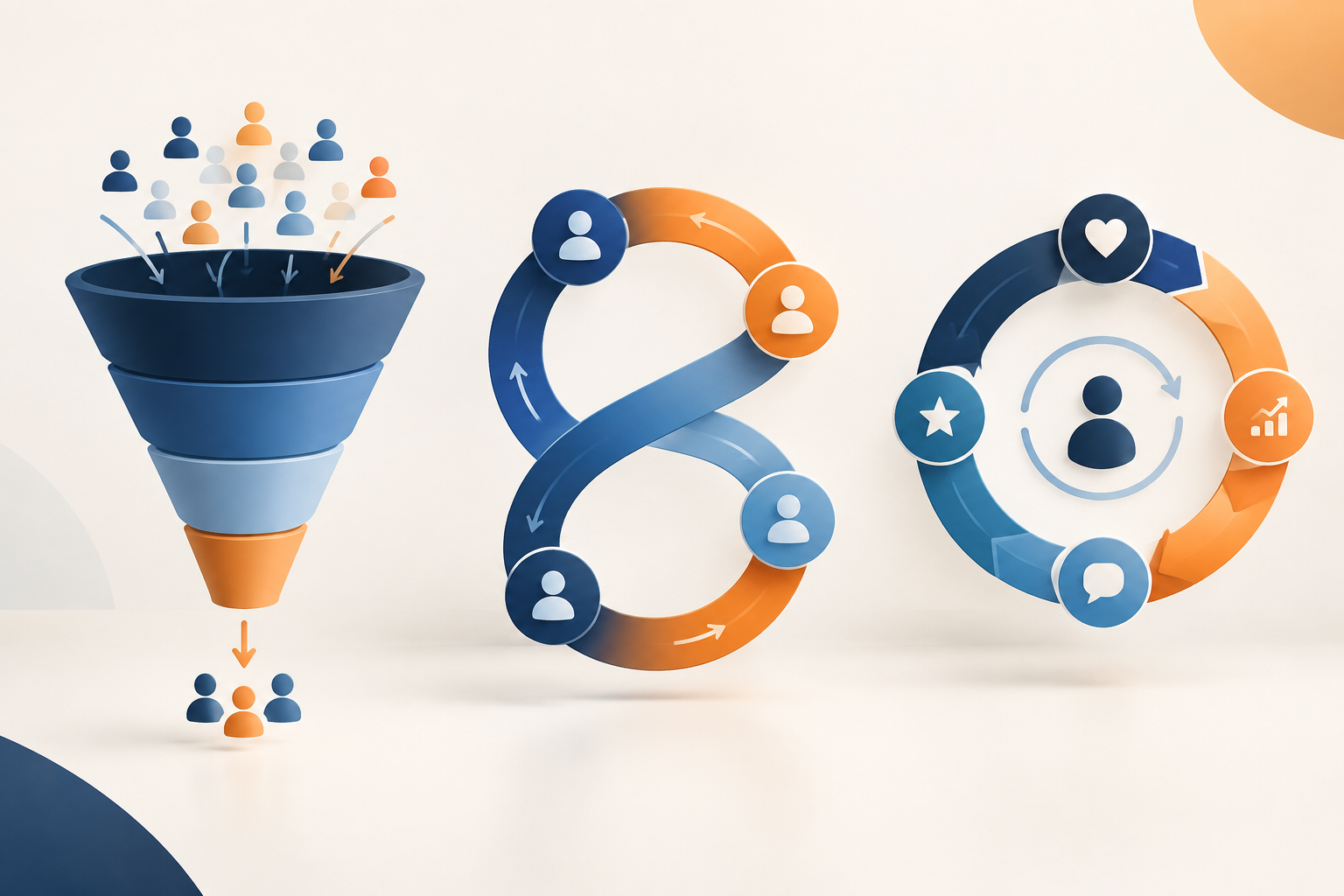
What are marketing funnel models and types, and why do they matter to growth?
Marketing funnel models simplify the path from first attention to commercial value. They matter because profitable growth depends on the movement between stages, not simply the volume entering at the top.
A business selling a lower-priced consumer product may need to understand product discovery, purchase conversion, repeat purchase, and referral. An Education business selling a higher-consideration programme may need to see the journey from audience attention to qualified enquiry, sales conversation, enrolment, learner activation, completion, and renewal or referral.
What a funnel model can show
A funnel model can reveal where customer progress slows, where cost rises, and where expected revenue does not materialise. It can help leadership see whether the constraint is:
- Insufficient demand from the right audience.
- Interest that does not become meaningful buying intent.
- Qualified prospects who do not convert during the sales or checkout process.
- New customers who purchase but fail to activate or receive value.
- Retention patterns that make customer acquisition costs difficult to recover.
That distinction matters. A business with weak demand needs a different decision from a business with strong demand but poor purchase conversion. Treating both as a lead-generation problem produces more activity, not necessarily more profit.
What a funnel model cannot solve on its own
A model does not repair positioning, pricing, product-market fit, fulfilment quality, sales capability, or cash constraints. It makes those problems more visible. The management work is deciding which constraint deserves attention first and ensuring the responsible team has the mandate to fix it.
Why more traffic can magnify a broken revenue system
More traffic can be valuable when acquisition economics are understood and downstream conversion is stable. It can also accelerate losses when prospects reach an unclear offer, a weak qualification process, a broken checkout, or an onboarding experience that fails to deliver early value.
Before expanding acquisition, leadership should understand CAC, contribution margin, payback timing, conversion by meaningful stage, customer retention, and available cash. Traffic is an input. Profitable customer growth is the outcome.
What is the difference between a traditional marketing funnel and a modern marketing funnel?
The traditional marketing funnel is a useful linear view of how awareness becomes purchase. A modern marketing funnel adds the reality that customers research across touchpoints, return later, compare alternatives, leave and re-enter, and continue creating or destroying value after purchase.
How the traditional marketing funnel helps
The traditional marketing funnel usually moves from awareness to interest, consideration, and purchase. It remains useful when the business needs a simple way to organise communication, measure broad conversion movement, and establish accountability between marketing and sales.
For a new offer or early-stage growth team, a linear model can create needed discipline. It forces basic questions: Who knows about the offer? Who is considering it? What action signals purchase intent? What percentage converts?
Where a linear funnel becomes incomplete
Customers rarely move in a clean sequence. A parent evaluating an education programme may research for weeks, seek recommendations, attend an event, compare alternatives, delay a decision, and return after a trigger. A consumer may discover a brand on social media, research independently, buy through a marketplace, and never interact with the original campaign again.
The consumer purchasing decision process includes information search, evaluation, purchase, and post-purchase evaluation. That is why a funnel that ends at purchase is incomplete for many Education and B2C businesses.
How retention and advocacy change the CEO view
A modern marketing funnel includes what happens after conversion. Customers who activate quickly, receive the promised value, repurchase, renew, and refer others improve the economics of acquisition. Customers who churn quickly or fail to use what they bought can make apparently successful marketing unprofitable.
A customer journey funnel framework can therefore include awareness, appeal, research, action, and advocacy. It should not be treated as a fixed customer sequence. It is a management view that helps the business connect marketing, sales, delivery, and retention around the real customer decision.
Which types of marketing funnel are most useful for Education and B2C businesses?
No single model is best. The most useful types of marketing funnel are the ones that match your purchase decision, sales motion, and customer value cycle.
| Funnel type | Best used for | Primary leadership question |
|---|---|---|
| AIDA or communication-led model | Brand messaging, campaign planning, creative effectiveness | Are we moving the right audience from attention to action? |
| Awareness, consideration, conversion | Simple direct-to-consumer paths and early funnel visibility | Where does prospect momentum decline before purchase? |
| Lead-to-sale funnel | Higher-consideration education offers and sales-assisted purchases | Does demand become qualified sales opportunity and enrolment? |
| Lifecycle funnel | Subscriptions, repeat purchase, memberships, education journeys | Do customers activate, retain, and create enough value after acquisition? |
| Flywheel or advocacy model | Referral-led businesses and brands with strong community effects | How does customer success contribute to future demand? |
AIDA and other communication-led funnel models
AIDA, meaning attention, interest, desire, and action, is useful for evaluating whether communication is doing its job. It is particularly helpful when the immediate issue is message clarity, creative performance, or whether the offer gives a prospect a reason to move forward.
Its limitation is that it does not show delivery quality, retention, margin, or cash recovery. Use it as a communication model, not as the entire commercial operating model.
Awareness, consideration, conversion models
This simple model is often enough for a business with a short buying journey and a direct checkout. It helps distinguish weak reach from weak evaluation and weak purchase conversion.
It becomes less sufficient when sales teams qualify leads, when the customer must complete meaningful onboarding, or when long-term retention is essential to the economics.
Lead-to-sale funnels for higher-consideration offers
Education businesses commonly need a lead-to-sale model. The critical stages are not merely ad click and form completion. They include whether an enquiry meets the programme’s stated fit criteria, whether the prospect reaches a meaningful conversation or evaluation point, and whether the sales process converts appropriate prospects without creating buyer regret.
A large lead count can conceal a specific failure mode: prospects may be curious but lack the urgency, budget, eligibility, decision authority, or intended use case that the offer requires. That is not a vague quality issue. It is a mismatch between acquisition, qualification, offer, and sales process.
Lifecycle funnels for subscription, education, and repeat-purchase businesses
Lifecycle models follow the customer after purchase. They are essential when first revenue is only the start of the economic relationship. For an education business, activation might mean beginning the programme, attending early sessions, or reaching an initial value milestone. For a subscription business, it may mean completing the actions that make renewal likely.
Flywheel and advocacy models
A flywheel model is useful when satisfied customers materially create new demand through referrals, reviews, community participation, or repeat purchasing. It reminds leadership that customer experience is not just an operations matter. It can influence future acquisition efficiency.
How should a CEO choose the right marketing funnel model?
Choose the model that reflects the commercial decision your business needs to make now, not the model that is most popular in a marketing presentation.
Choose based on the buying decision, not the marketing channel
Social media, search, email, affiliates, events, and paid media are channels. They are not funnel models. The same customer may use several channels before deciding. Start with how customers evaluate the offer, what commitment they are making, and what must happen for the business to earn contribution margin.
Match the model to the sales motion
A direct purchase with a low-friction checkout can be managed through attention, evaluation, purchase, and repurchase. A sales-assisted offer needs visibility from initial enquiry through qualification, sales progress, conversion, and early customer success.
The more time, money, risk, or identity a buyer attaches to the decision, the more important it becomes to understand the evaluation and handoff stages rather than focusing solely on lead volume.
Use one primary model before adding secondary views
Leadership teams often create too many funnel views and end up with competing definitions. Select one primary model that represents the revenue engine. Add secondary views only where they answer a distinct question, such as campaign communication, sales pipeline health, or customer retention.

What marketing funnel steps should be mapped in every business?
Every business should map the movement from demand to retained economic value, even though stage names and detail will vary.
- Demand creation: The right market becomes aware of a relevant problem, category, or offer.
- Qualified intent: A prospect takes an action that indicates meaningful fit or purchase interest.
- Evaluation and conversion: The prospect assesses the offer and completes the purchase, enrolment, or sales process.
- Activation or delivery: The customer reaches an early point where promised value becomes real.
- Retention and expansion: The customer stays, repurchases, renews, upgrades, or refers where relevant.
From attention to qualified intent
Attention is not intent. A video view, website visit, or content download may signal early curiosity, but it does not necessarily indicate a customer worth acquiring. The business should define what action or evidence represents a meaningful step toward purchase.
From evaluation to conversion
Conversion is not only a transaction. It is the point at which a customer makes a credible commercial commitment. For some businesses, that happens at checkout. For others, it follows eligibility review, consultation, application, demonstration, or financing approval.
From purchase to activation, retention, and expansion
The post-purchase handoff is often where funnel reporting ends and value leakage begins. If a customer has bought but does not start, use, complete, or benefit from the product, the commercial system has not completed its job.
How does a marketing funnel model connect to unit economics?
A funnel model becomes a management tool when every meaningful movement is linked to economics. Revenue alone does not tell you whether growth is profitable, cash-efficient, or durable.
The relationship between conversion rate, CAC, and payback
At a high level, customer acquisition cost can be expressed as:
CAC = acquisition investment ÷ new customers acquired
If conversion declines while acquisition investment stays constant, CAC rises. If contribution margin is thin or cash is collected slowly, a higher CAC may lengthen payback beyond what the business can responsibly fund.
Payback considers how long contribution margin from acquired customers takes to recover acquisition cost. The acceptable period depends on the company’s margin structure, cash position, refund exposure, cohort behaviour, and confidence in retention. It is not a universal benchmark.
Why revenue is not the same as profitable growth
A campaign can produce revenue while reducing profit if it relies on excessive discounting, attracts customers unlikely to activate, or brings in a cohort with weak retention. Likewise, a sales team can close more customers while creating delivery strain, cancellations, or refund risk.
The CEO question is not, “Did marketing produce revenue?” It is, “Did this acquisition create contribution margin and recover cash within an acceptable period?”
How retention changes what acquisition can responsibly cost
Retention can justify higher acquisition investment only when it is evidenced in mature cohorts and supported by margin. A forecast of lifetime value is not the same as realised customer value. Businesses should be especially cautious where cohort timing is immature or where the offer has recently changed.
How do you map a marketing funnel without creating a reporting exercise?
Map the funnel around real customer progress and commercial consequence, not around every platform metric available.
Start with the buying journey and the revenue event
Begin with the customer decision: what triggers the search, what risks the buyer is managing, what evidence they need, and what commitment represents conversion. Then map what must occur for the business to recognise quality revenue and realise margin.
Define stage transitions that represent real customer progress
A stage should change only when the customer has done something commercially meaningful. For example, an enquiry becoming eligible for an offer is more meaningful than an arbitrary lead status change. A customer completing an early onboarding milestone is more meaningful than simply receiving a welcome email.
Separate leading indicators from financial outcomes
Leading indicators can show whether the system is moving before revenue appears. Financial outcomes show whether the movement is economically worthwhile. Both are necessary, but they should not be confused. Clicks, traffic, and enquiries are not substitutes for margin, payback, or retention.
What does a healthy versus broken funnel pattern look like?
A healthy funnel does not mean every metric rises every week. It means leadership can explain where movement is changing, why it is changing, and what that means for economics and capacity.
When demand exists but intent is weak
High traffic with limited progression into meaningful evaluation can indicate a mismatch between message and offer, broad targeting, misleading creative expectations, or content that attracts research interest without purchase relevance. The answer may be sharper positioning, better audience selection, or a clearer next step, not simply more traffic.
When qualification and sales handoff are failing
When enquiries meet stated fit criteria but do not become sales conversations, investigate speed of follow-up, contactability, handoff ownership, buyer expectations, and the friction required to progress. When prospects reach sales conversations but conversion falls, inspect offer clarity, sales diagnosis, objection patterns, affordability, competitive alternatives, and buyer confidence.
When the offer or conversion experience is the constraint
Strong interest and weak checkout or enrolment conversion may point to pricing presentation, payment friction, unclear inclusions, risk concerns, technical errors, or insufficient proof. It should not automatically be blamed on channel quality or sales effort.
When retention makes acquisition economics unsustainable
If first purchases are strong but customers fail to activate, renew, repurchase, or remain engaged, acquisition may be outrunning delivery and customer value. The priority becomes onboarding, product experience, support, expectation setting, or offer fit before aggressively scaling demand.

Which growth bottlenecks can funnel models reveal?
Funnel models reveal where the business should focus, provided the data is interpreted alongside customer feedback, operational reality, and unit economics.
- Demand creation bottleneck: The right market is not seeing, remembering, or understanding the offer.
- Intent bottleneck: Attention does not translate into actions that indicate genuine fit and buying readiness.
- Conversion bottleneck: Appropriate prospects are not completing checkout, enrolment, or a sales process.
- Activation bottleneck: New customers do not reach the first meaningful value moment.
- Retention bottleneck: Customers leave, fail to repurchase, or do not generate expected margin over time.
- Measurement bottleneck: Stage definitions, attribution, ownership, or financial data make it impossible to identify the true constraint.
These bottlenecks frequently interact. Weak positioning can create an intent problem. Weak qualification can create apparent sales underperformance. Weak onboarding can make CAC look too high because customer value never develops. The task is to find the dominant constraint, not attempt to fix every metric at once.
What should be measured on the CEO funnel dashboard?
A CEO dashboard should be compact enough to drive decisions and broad enough to connect acquisition with customer value and cash.
Volume and conversion metrics
Track meaningful demand, qualified intent, sales or checkout progression, new customers, and conversion between major stages. Trends are more valuable than isolated snapshots, particularly when campaigns, offers, or seasonality change.
Economics and cash metrics
Include acquisition cost, revenue quality, contribution margin, payback timing, refunds or cancellations where relevant, and available cash context. These measures determine whether more acquisition investment is sensible.
Cohort and retention metrics
Review activation, retention, repeat purchase, renewal, or completion by customer cohort. Cohorts help distinguish a one-off revenue spike from a customer group that is likely to create durable value.
Questions the dashboard should answer every week
- Where is customer progression slowing?
- Which change has the largest economic effect?
- Are recent customers activating and retaining as expected?
- Is CAC moving in a way that margin and cash can support?
- What is the single most important constraint to address next?
How should funnel insight change spend, hiring, and agency decisions?
Funnel insight should change resource decisions by showing whether the next constraint is acquisition, conversion, delivery, retention, or measurement.
When increasing acquisition investment may be justified
Increasing acquisition investment may be justified when qualified demand can be generated predictably, conversion is stable, contribution margin supports CAC, payback is acceptable for the company’s cash position, and recent cohorts are activating and retaining in line with expectations.
It should not be based solely on a desire for more leads or a short-term revenue target.
When fixing conversion or retention should come first
If qualified prospects are failing to convert, or new customers are failing to activate and retain, further acquisition can compound the problem. Investment may be better directed toward the offer, conversion experience, sales process, onboarding, or delivery capacity.
How to evaluate marketing agency performance through funnel evidence
An agency can be executing well within a system that has an offer, qualification, sales, retention, or measurement problem. Equally, an agency may be failing to create the intended demand or provide reliable channel execution.
Evaluate performance against the part of the funnel the agency owns, while also examining the full customer path. If campaigns generate relevant demand but sales conversion collapses, replacing the agency may not solve the constraint. If channel work does not generate the agreed type of demand despite a clear offer and sound measurement, the vendor relationship deserves scrutiny.
What should be checked in a Growth Audit?
A Growth Audit should establish whether leadership has a reliable view of the revenue engine and can identify the highest-leverage constraint with confidence.
The customer journey and offer check
Confirm the primary funnel model reflects the actual buying decision. Check whether customer segments, offer promise, purchase friction, and delivery expectations align. If the promise that creates demand differs from the experience delivered after purchase, the funnel will eventually show strain.
The conversion and economics check
Review the major stage transitions alongside CAC, margin, payback, refunds, retention, and cohort timing. The goal is to locate the biggest economic leak, not to produce a longer list of marketing tasks.
The ownership and execution check
Clarify who owns demand creation, qualification, sales handoff, conversion, customer activation, and retention. A funnel frequently breaks at the boundaries between teams. When no one owns the handoff, the customer experiences the gap and the business absorbs the cost.
A Growth Audit is particularly relevant when the leadership team cannot confidently explain why growth has slowed, why acquisition costs have changed, or whether the next decision should involve marketing investment, conversion improvement, delivery capacity, or retention.
For a stage-by-stage breakdown, see our marketing funnel stages guide.
Frequently asked questions about marketing funnel models and types
The main types include AIDA and other communication-led models, awareness-consideration-conversion funnels, lead-to-sale funnels, lifecycle funnels, and flywheel or advocacy models. Each answers a different commercial question.
Yes. The traditional marketing funnel is useful for understanding the movement from awareness to purchase. It becomes incomplete when retention, repeat purchase, customer success, referrals, or sales-assisted evaluation materially affect profitability.
A marketing funnel is a business model of stage progression and conversion. A customer journey describes how the customer experiences the decision, including research, emotions, touchpoints, delays, and post-purchase evaluation. The strongest management view uses both.
Track enough stages to expose meaningful commercial handoffs, but not so many that definitions become unreliable. Most businesses need visibility from demand through conversion and into activation and retention. The exact number depends on buying complexity and the sales motion.